Showing posts with label Stocks and Soups. Show all posts

Friday, February 18, 2011

A Big Bowl of Red - Grassfed Steak Chili

A few weeks ago, I had the opportunity to represent the restaurant at Chelsea Market's NY Chilifest 2011. I along with representatives from our other two restaurants in our group, spent several hours ladling out some damn good chili and schmoozing away a Sunday afternoon. It was the first public cooking event I participated in and I had no idea what to expect. All the meat for the chili cookoff was provided by Dickson's Farmstand Meats, and ticket proceeds were being used to support Food Systems NYC - both supporters of local and sustainable food production. Restrictions allowed three people from each restaurant to attend and serve their (hopefully) award-winning chili to 1200 people, and promote their restaurant. One of the tricky things was how to transport 50 gallons of hot chili to the event and keep it warm on only two small hot plates. The solutions were as varied as the chilis. One of our neighbors even brought their own electric steam tables and trays, only to find that there was no access to power - only butane.

The event started at 4pm and for the first couple of hours there was just a sea of people stopping from table to table, chili mug in one hand and a beer in the other. There were television people there, filming, and asking each team to describe their chili. There were also a host of photographers, one of whom stopped me at one point, saying "that's perfect, don't move." At another moment, I turned around to find a mic in my face and a video camera pointed at me. My cohorts had thrown me to the wolves. Here I was, having had nothing to do with preparing our chili, yet now being asked by a reporter to describe it. I am sure during the course of this event, I did or said something dumb that is somehow going to end up in print with my real name attached to it. Oh well.

By the time two hours had elapsed, even the most hearty looking chili-eater was passing our table by, putting a hand over his stomach and gesturing that he could eat no more. And at 6:30 the judges had made their decision and announced the winner of the competition. Unfortunately the judges did not award us the Golden Chili Mug, but we got a good response from the public, and our chili was pretty much gone, so we took the chance to sample some of our competition. There was everything from Texas style "bowl of red," sans beans, to very traditional Mexican style chili, to more unexpected and modern "chef" interpretations. Of course, Fette Sau, a barbecue joint located in Williamsburg added some pork to their chili, and Telepan presented a green chili that contained kernels of hominy. Even the Food Network test kitchen had a table. The aroma of beef, chiles, and spices from the various tables lingered throughout the concourse at Chelsea market. I could only imagine the aroma that could very well follow as 1200 people digested the 20-30 ounces of chili served to them by all the restaurants, and all the beer provided by Brooklyn Brewery. Once our chili-pot was empty, we certainly didn't stick around long enough to find out.

Since I didn't actually participate in the chili-making for the event (credit goes to my executive chef and his team at my former restaurant), I have been meaning to put up a big pot of red chili for me and the old boyfriend. After some hectic days at the restaurant following the departure of the Hulk, and gearing up for Valentine's Day, I finally had a day off. So last night I thawed out 2 lbs. of Manx Station Farms grass fed steak I had knocking about my freezer (from Basis Foods, of course) and made a pot of slow cooked steak chili. I often make a chili with spicy chorizo, chipotle peppers, and mole style spices. But this time I decided to keep it simple and go with a basic American style chili: red and black beans, tomatoes, onions, red bell pepper, garlic, chili powder, cumin, and cayenne. Okay, so I did add a little cocoa powder at the end for some richness, but just a little. We enjoyed it in front of the tube, watching one of our more recently discovered favorite movies: Jeff Daniels' Escanoba in da Moonlight. In case you haven't seen it, think The Hangover, meets Parenthood but better.

Grassfed Steak Chili

INGREDIENTS:
2 lbs. grass fed (or whatever) steak, diced
vegetable oil
1 large onion, diced
2 red bell peppers
1/4 c. chili powder
1 Tbsp. ground cumin
1 tsp. cayenne pepper
6 cloves of garlic, minced
1 Tbsp. tomato paste
14 oz. cooked black beans
14 oz. cooked red kidney beans
28 oz. can of crushed tomatoes
water
1 Tbsp. unsweetened cocoa powder
salt and black pepper to taste

PROCEDURE:

1. Coat the bottom of a large dutch oven with oil and cook the onions and red pepper with the spices over medium low heat until soft. Add the tomato paste and garlic and cook for a few seconds until the garlic is fragrant.

2. Add the meat and cook until it is no longer pink. Add the beans and tomatoes, and enough water to cover all the ingredients. Simmer gently, covered for 45 minutes, then uncovered for another 45 minutes. until the meat is very tender. Stir in the cocoa powder and add salt and pepper to taste.

3. Serve garnished with sour cream or grated monterey jack cheese and sliced green onions.

TIP: Chili, like stew always tastes better the next day, after all the flavors have had a chance to mingle.

Try this with : Maple Glazed Cornbread

All the meat for the chili cookoff was provided by Dickson's Farmstand Meats, and ticket proceeds were being used to support Food Systems NYC - both supporters of local and sustainable food production.

Thursday, June 17, 2010

Chicken Soup with Fresh Spaeztle

Chicken Soup with fresh Spaeztle, made from remnants of a failed experiment.
Cooking can be very frustrating when things don't work out as planned. Last week I was so excited about finding fresh cranberry beans at my local market I had to pick some up. Along with that I picked up some kielbasa, a chicken, and some basics: onions, carrots, celery, herbs etc. It was unseasonably cool, and I had in mind a one-pot meal of braised chicken with pork and beans. Well, I won't go into the gory details, but it wasn't one of my best laid out plans. My estimated cooking times for all the different ingredients were off - a very important factor if they are all going into the same pot, I might add - and I ended up with undercooked beans, and dry, bland, chicken. Well, all the stereotypical temperamental chefs came to life in my kitchen that evening - so much so that I heard the boyfriend whisper to Sadie, "Leave mama alone, it's not safe in the kitchen right now." When I was through throwing my tantrum, I wrapped the chicken up and put it in the fridge, finished cooking the beans through, then seared some slices of kielbasa, and fried a couple of eggs. We ended up having mediocre but edible Kielbasa and Beans with Fried Eggs for dinner.

The one positive result of that evening was that I managed to use all the chicken carcasses I had stored up in my freezer to make a giant batch of chicken stock. It really came in really handy a couple days later, when the boyfriend came down with a cold and a bad sore throat. Cheers! Chicken soup to the rescue. I love a good chicken noodle soup, and having fresh chicken stock, and leftover chicken in the fridge always makes quick work of it. I didn't have any egg noodles in my pantry, but I did have eggs, flour, and milk to make Spaetzle instead. It was so quick and easy, I don't think that my Chicken Soup will ever see another dried egg noodle.

Chicken Soup with Fresh Spaeztle

INGREDIENTS, makes about 3 quarts
3-4 Tbsp. neutral oil (such as canola or grapeseed)
3/4 cup diced carrots
3/4 cup diced celery
1 cup diced onion
1 clove of garlic minced
2 quarts chicken stock, preferably unsalted
a bouquet garni of fresh thyme, oregano, and a bay leaf, tied together with twine or bound in cheesecloth
salt and pepper
the meat of one 3-4 lb. chicken, cooked, skin and bones removed, and cut into 1/2" chunks

For the Spaeztle:
2 eggs
1/3 cup milk
1/4 tsp. salt
pinch of nutmeg
pinch of cayenne pepper
1 cup flour (6 oz. by weight)

SPECIAL EQUIPMENT:
A stockpot with a fitted steamer insert or a metal/heatproof colander that will rest on the rim of your soup pot.

PROCEDURE:
1. Combine the carrots and celery and a couple tablespoons of oil in a tall 8 quart stockpot. Season with salt and pepper and cook over medium low heat for about 5 minutes. Add the onions and garlic, and additional oil if needed to coat the onions, and cook for another 5-10 minutes or until the onions are translucent.

2. Add the chicken stock and herbs, then turn the heat to high and bring the mixture to a boil. Lower the heat and simmer gently until the celery and carrots are almost cooked through.

3. Meanwhile make the spaetzle batter. In a medium bowl, whisk together the eggs, milk and spices. Then add the flour and mix with a whisk or spoon until uniform. Cover the bowl with plastic wrap and set aside.

4. When the vegetables are close to cooked through, transfer the spaeztle batter the colander or steamer insert. Place the steamer insert in the stockpot, or if you are using a colander, rest it on rim of the stockpot. There should be a couple inches of space between the bottom of the insert/colander and the liquid. Turn the soup to high and using your rubber spatula, push the batter through the holes of the colander so the pieces drop into the boiling soup. It will only take a minute or so for the spaeztle to float to the surface - a good indication that they are cooked. When you think you have enough noodles, simply remove the insert/colander and discard any remaining batter.

5. Add the cooked chicken to the pot and bring everything back to a boil, just to warm the chicken through. Season to taste with salt and pepper.

Notes:
The recipe calls for a generous amount of chicken stock to account for the liquid absorbed by cooking the spaeztle directly in the soup. I prefer this method only because the starch adds body to the soup the same way adding pasta cooking water to sauces does. You may prefer to cook your spaeztle in a separate pot of salted water to have better control over the cooking process.

This recipe is best made with homemade Chicken Stock.

Monday, January 12, 2009

Starting From Scratch: Classic Chicken Stock

Especially in the winter, one of the things I like to keep on hand is Chicken Stock.  When made properly, it has a delicate flavor that is not only a great base for soups, but adds flavor to rice or risotto, and is delicious for poaching vegetables too.  By using quality ingredients, the chicken stock you make will be far superior than store bought, and won't contain tons of sodium.  If you buy whole chickens and butcher them yourself, you will get even more bang for your buck.

A common misconception is that you simply dump chicken scraps and vegetable scraps into a pot, fill it with water, and boil the hell out of it. The tendency is also to put in way too much water and too many vegetables. The result is usually a cloudy vegetable stock with little chicken flavor instead of a clear, flavorful chicken stock.

The key to flavorful chicken stock is in the proportion of chicken bones to vegetables, or aromatics. The aromatics should comprise only 15-20% of total weight of bones. That's a 5:1 ratio of bones to vegetables, maximum. The French use a combination of onions, carrots, and celery, known as mirepoix, sometimes with the addition of some leek whites. In Chinese and Asian cooking, the aromatics are often comprised of ginger, garlic, and scallions. Whatever you use, keep your aromatics simple. Don't use vegetables that will break down and cloud your stock, such as potatoes. Also stay away from aggressive flavors such as asparagus, cabbage, etc. and dark green vegetables that will leach out and discolor the stock.
Other keys to remember:

Use only enough water as needed. Use a tall stockpot to minimize evaporation, and add only enough water to cover the bones by about 1 to 2 inches. If the liquid gets low, you can replenish by adding a little hot water to just keep the bones covered. Never cover the stockpot.

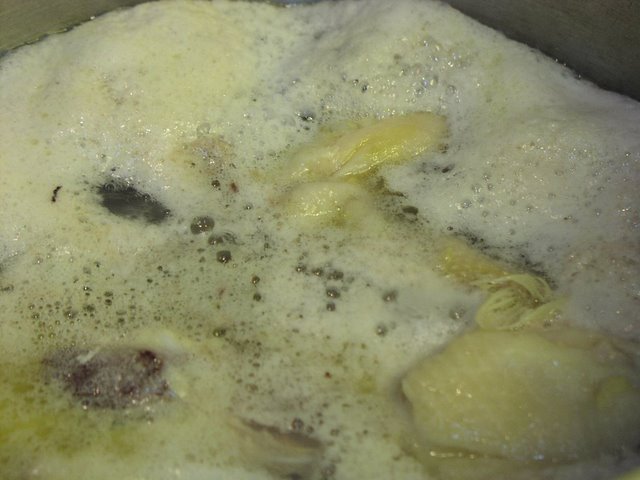
Skim, skim, skim. As the stock simmers, the bones will release impurities and fat that rise to the top, which you must remove. As the fat comes in contact with the air, it will congeal slightly, making it easier to skim. Most of the crud will be released in the first hour and should be removed before you add your aromatics. Then a periodic check for fat and foam should suffice.

Let that baby simmer. Whatever you do, don't stir things up and don't let your stock boil. Both of these will cause it to be cloudy.

Ingredients, makes approximately 3 quarts:
3 lbs. chicken bones, rinsed in cold water
1 small yellow or white onion, approximately 5 oz.
1 medium carrot, approximately 4 oz.
1 stalk of celery, approximately 1 oz.
2-3 bay leaves
1 bunch of fresh thyme
1 Tbsp. whole black peppercorns
a few parsley stems, if available.

Procedure:
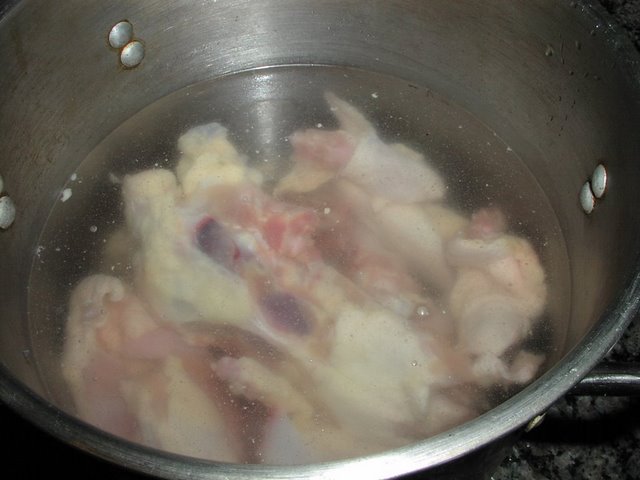
1. Place the chicken bones in a tall 8 quart stock pot. Cover with about 1 to 2 inches of cold water and bring to a boil. Lower the heat and simmer for one hour, periodically skimming any foam and fat that rises to the top.

Use just enough water to cover the bones

Foam and fat rising to the top
2. Meanwhile prepare the remaining ingredients. Peel and chop the onions and carrots into 1" - 1-1/2" chunks. Cut the celery the same size.

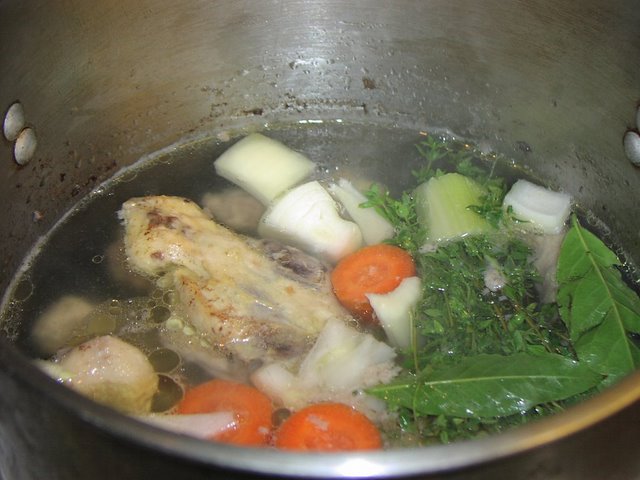
3. After the first hour, the bones will have released most of their impurities. At this point, add the rest of the ingredients and simmer for another 2-1/2 to 3 hours. Fat, and some remaining impurities will continue to rise to the top of the liquid, and should be skimmed from time to time. It is helpful to keep hot water on hand to replenish the liquid as needed to keep the bones submerged.

Stock after simmering for 1 hour is clearer and ready for aromatics
4. After 2-1/2 to 3 hours of simmering and skimming, the stock should be ready. You will notice that it has become quite clear, and you should be able to see the ingredients that have settled to the bottom through the liquid. Taste your stock. It should be flavorful, and taste of chicken, not vegetables.
5. Strain your stock through a fine mesh sieve or a colander lined with cheesecloth. Discard the vegetables. The bones can be saved and used a second time to make a Remouillage*.

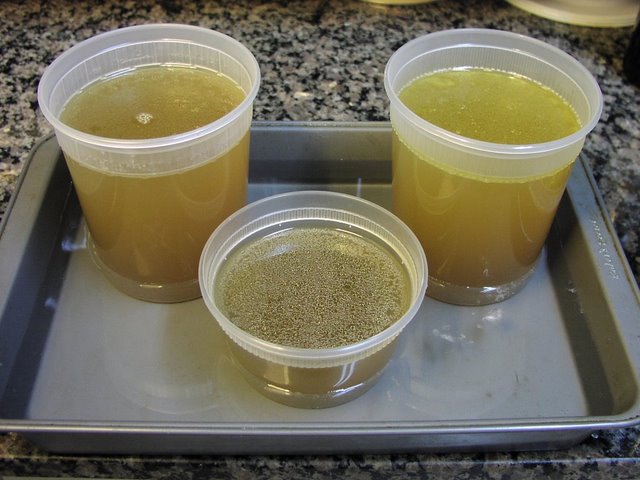
Finished stock, cooling
6. If you are not using it right away, it is important that you cool your stock quickly so that you can get it into the refrigerator or freezer. I usually divide the stock into quart size containers and sit them in a baking dish or roasting pan filled with ice water. When they have cooled to room temperature, cover and label the containers and refrigerate or freeze. If you will be freezing your stock, make sure to allow an inch of airspace in your container for expansion.

*Remouillage - This refers to both the process and the secondary stock obtained by simmering stock bones a second time, in order to extract the remaining gelatin.  The remouillage will not have the flavor of a primary stock, but can be used as a base for new stock, or reduced to concentrate the gelatin, and used to add body to soups or sauces.

Related Pages:
Butchering Chicken
AMAZON