Monday, January 24, 2011

Maple Glazed Cornbread, a Delicious Meeting of North & South


Have a bite of this with your morning coffee!
I am obsessed with cookbooks, as I am sure most avid cooks and food bloggers are. From my slowly growing collection I make lists and lists of recipes, techniques, and new things to try. I especially love when the author gives us a little glimpse into how the recipe evolved, information about the ingredients, and where they come from, etc. Still I find my favorite recipes usually come to me not from cookbooks, magazines, internet, or a food focused television network (need I speak the name?), but by word of mouth. This cornbread is made from one such recipe.

The original recipe was given to me by a pastry cook friend of mine, who was sworn to secrecy by her friend, whose Southern forebears would probably roll over in their graves knowing that their heirloom recipe had been passed along to a Yank like me. Until that day I had never been able to produce a moist delicious cornbread from any recipe I tried. Even the Joy of Cooking let me down, and forget the recipe on the back of the cornmeal package. Every attempt resulted in dry, crumbly bread - barely edible when fresh, and definitely not edible the next day. This, I have sadly come to learn, is what distinguishes Northern style cornbread from it's Southern cousin. Northern cornbread is traditionally a savory affair, with a higher proportion of cornmeal, often omitting flour altogether. Was I wrong to want the kind of cornbread I loved at barbecue joints - that sweet, moist bread that was just perfect for mopping up sticky meaty barbecue sauce dripping from a rack of St. Louis pork ribs?

Well, this was it. However, my adaptation differs from the original on two points. First, the recipe given to me called for a portion of cake flour, which is not something I always have on hand. I make it with 100% all purpose flour and actually prefer that it's not as cakey and has a nice looser crumb. The second adjustment is in the glaze. The original recipe calls for a glaze of honey, butter, and water, but I have added that old Yankee flair by using maple syrup in place of honey, and adjusting the proportions to account for it. Applied after the cornbread has baked and has had time to cool slightly, the glaze is the magic key to keeping it moist and buttery. It is even good cold, and will never need to meet a pat of butter. It keeps well, stored in an airtight container at room temperature for up to two days, but I have never seen it sit around for that long.

By the way, anyone who wants to try the original recipe can send me a message and I will be happy to send it to you. However I cannot so publicly breach a confidence as by publishing it. Cheers.

INGREDIENTS, for (1) 9" x 13" cake pan:
2 c. cornmeal
2 c. sugar
2-1/2 c. all purpose flour
2 Tbsp. baking powder
1 tsp. salt
4 eggs
1/3 c. corn, or other neutral cooking oil
1 c. milk
1/2 c. buttermilk
3 oz. (6 Tbsp.) brown butter (see step 3 below)

GLAZE:
1-1/2 oz (3 Tbsp.) butter
1/3 c. pure maple syrup (not the fake stuff, please)
1-2 Tbsp. water
a pinch of salt (optional)

PROCEDURE:
1. Preheat oven to 375 degrees. Spray the baking dish or grease with butter.

2. In a large bowl, whisk together the cornmeal, flour, sugar, baking powder, and salt. In a separate bowl mix the eggs, corn oil, milk, and buttermilk.

3. Meanwhile, make the brown butter. Place the 3 oz. of butter in a small saucepan or saute pan and melt over medium-high heat. Watch it. First the butter will melt, then it will start to foam as the fat separates from the milk solids, visible as white granules or clumps. Once all the water in the butter has evaporated, the milk solids will start fry. Once they are lightly browned and take on a nutty aroma, the butter is ready. Remove immediately from the heat, and be careful because brown butter is VERY HOT. It will continue to cook even after you have taken it off the heat , so let it cool some before using it. Also, take care that you don't burn the butter or it will impart a bitter, carbon like flavor to your bread.

4. Make a well in the center of the dry ingredients and pour in the egg and milk mixture. With a few swift strokes of a wooden spoon or whisk, mix them together briefly. Pour in the cooled brown butter and stir in immediately until the batter is just smooth and uniform, taking care not to overwork it.

5. Pour the batter into the baking dish and bake in on the middle rack of the oven for 30 minutes or until a skewer stuck in the middle comes out clean or with only some crumbs sticking to it. Let cool 5-10 minutes.

6. While the cornbread cools, make the glaze by simply heating all the ingredients together in a small saucepan until the butter is melted. Whisk or stir it briefly to combine the butter with the water and syrup. Using a pastry brush, dab the glaze all over the top of the cornbread. Allow the glaze to absorb and set before cutting the cornbread.

Sunday, October 31, 2010

The Importance of Being...Inspired

Oh a busy busy busy bee is me! I know it's been months since my last post, but between having a new puppy, caring for old cats, resolving yet another car accident (not my fault, I wasn't even in the car), my novice attempts at gardening, and the demands of the restaurant, I don't know where all that time went. A girl can get pretty jaded, living in such a whirlwind. Thank goodness I recently had a birthday, which always makes me restless to shake up my routine, and reflect on what my goals are for the next year to come. Some people make new year's resolutions. Instead I make birthday resolutions.

Resolution number one is to actively stay inspired. Sure, a strong routine can be very valuable for a line cook. It helps you set up your station on time, multi-task during service, and strive toward machine-like precision and consistency. But it can be very easy to let the machine take over and to forget why you're working so hard in the first place. So I'm trying to take better advantage of the city, and see what other chefs are doing from my ever-growing list of restaurants to check out. On a line cook's pay, that's certainly not easy, but at least on my birthday, Boyfriend was picking up the tab!

So for my birthday dinner I chose Degustation, one of the top restaurants on my list. Serving a menu of small plates from an open kitchen surrounded by only 19 seats, it's definitely a restaurant designed with industry folks and food & wine enthusiasts in mind. A friend who recently left the kitchen at Prune to follow her med student fiance to Grenada (winter in the caribbean? me? jealous?) raved about Degustation after having their anniversary dinner there a few months back. Then one of our cooks who recently relocated from the west coast touted his meal at Degustation as among the best he's had. Then when I told one of our bartenders I was considering going there for my birthday he said it was the best meal he'd ever had, and if I had any trouble getting reservations he knew someone who knew someone... So I figured it was time to go and see what all the fuss was about. My day off that week fell on a Tuesday, so I called Degustation that afternoon to make reservations for two. They could only fit us in either really early at 6pm, or later at 9pm because they were expecting a large party at 8pm. 6pm was too early so we took the 9pm reservation.

Degustation's unassuming exterior

Degustation's entrance, located on E 5th street off 1st avenue, is simple and unassuming. We almost walked right past the restaurant and probably would not have even noticed it if we weren't looking for it. In the dark, the name was barely visible on the solid front door, and the only light was a warm glow that emanated from two square, porthole like windows. We entered through the heavy door into a space that was contemporary and chic, yet warm and comfortable. The host greeted us and immediately showed us to our seats. I was delighted to find that we were seated right in front of the chef 's station, where executive chef Wesley Genovart was artfully plating all the food.

We started off our evening with a couple of beers as we looked over the menu and tried to decide whether or not to try a tasting menu. Boyfriend stuck with his usual Amstel light, while I sipped an Alhambra Negra, a dark Spanish lager with a soft caramel like flavor. The small plates menu featured a crudo of seasonal fish, coca mallorquina, carabinero, and other items also inspired by the chef's Spanish up-bringing. In addition to the a la carte small plates, the restaurant offers a five course tasting menu for $50 per person, and a 10 course tasting for $75 per person. When asked, our server kindly explained that both tasting menus were pre-determined for the evening and that the five course tasting featured only menu items, while the 10 course tasting also featured special items that changed daily, such as sweetbreads and some other things that I didn't hear after she mentioned sweetbreads. So we chose the 10 course tasting. Our server asked us if we had any allergies, which they would be happy to accommodate. No, we didn't, but Boyfriend was really excited to see oxtail among the small plates, so we asked if that might be included as one of our courses. "I'm sure we can make that happen," she replied.

The meal started with an amuse-bouche of two bite size menu items: a pork croqueta and Spanish "tortilla" filled with quail egg and shallot confit. The croqueta was crispy and flavorful, and paired nicely with its bed of paprika spiced aioli. The tortilla was much more delicate in texture and subtle in flavor. While I could appreciate the contrast, it seemed strange to pair the two on the same plate. It did a slight disservice to the tortilla, which I think was good, but whose subtlety was somewhat overpowered by the more assertive croqueta next to it.

Pork Croqueta and Spanish "Tortilla"
The first course was a delicious chilled marcona almond soup, simply garnished with chives, pea flower, and a marcona almond. It was milky and smooth, and perhaps there was just the slightest suggestion of roasted garlic which pleasantly enhanced the salty sweetness of the almonds.


Chilled Marcona Almond Soup

Our second course was a crudo of spanish mackerel served over tomato granita and topped with crispy slivered garlic and serrano chiles. The fish was fresh and firm, and I thought the tomato granita added nice chill and acidity to an otherwise oily fish, but Boyfriend did find the garlic too overpowering.


Crudo of Spanish Mackerel

Next, we were served the Puerro Salda, a warm pureed potato leek soup garnished with octopus, a Barron Point oyster, and padron pepper (which I believe was in the form of a green infused oil). Boyfriend did not like this soup. He found it overwhelmingly "fishy." I could see where he got that, since it had a familiar flavor that was reminiscent of braised abalone I'd eaten at Chinese wedding banquets as a child.

Boyfriend and I shared much discussion about the next dish, which was a trio of sardines. One was simply pan seared and served over roasted red pepper. The second, our favorite preparation, was the chef's play on a sardine sandwich, and featured a sardine seemingly dusted with rice flour, then fried and served over pickled onion and topped again with serrano chiles. The sardine was pleasantly crispy and the onions were tart and I thought I detected a hint of fish sauce in the brine. The third and least favorite was a sardine fillet rolled and served over sauce gribiche, whose flavor Boyfriend likened to the smell Tester's modeling glue. Humbly I must admit that I don't know what sauce gribiche is supposed to taste like, but I had to agree with Boyfriend on this one.

Trio of Sardines

Next the servers brought us bowls of seared durade with matsutake mushrooms, and eggplant. At the table, they finished the dishes with a matsutake mushroom broth. This was our fifth course, (sixth, if you include the amuse) and to be truthful, by now I was beginning to feel the food equivalent of "Museum Fatigue," a term from my art school days used to describe the kind of sensory overload and subsequent shut-down caused by viewing too much artwork in one visit to the museum. So I have to say that outside of enjoying the broth and the texture of the eggplant and the fish, I can't recall much about the dish's flavors.

Amazingly enough, the next course was just the thing to bring my senses back to life: a warm duck egg mouse with tiny brioche croutons, smoked maple syrup and a strip of lamb bacon all served in the eggshell. It was perfect. The mousse was light, airy, and was just the right temperature to evoke the warmth of a freshly laid egg. The croutons and the bacon were nice and crunchy, and the syrup underneath the mousse added a great sweet smoky finish. I asked Boyfriend, who normally does not like the flavor of lamb, what he thought of the lamb bacon, and he replied, "C'mon, it's bacon, of course it's good."


Duck Egg Mousse
After having my senses re-awakened, and hearing the server describe it, I was really excited about the next dish: coca Mallorquina with sobresada, wild mushrooms and a red wine reduction. It was good, but after experiencing the perfection of the duck egg mousse, I have to say the coca Mallorquina was a little disappointing. Inspired by a Spanish style pizza or flatbread typical of the Mallorca region, the crust was crispy, but the sobresada seemed a little dry and chewy, and the flavors, though good, were kind of lackluster.

Finally, grilled sweetbreads! I have to admit I had only had sweetbreads either dusted with flour and pan-fried, or poached and glazed with a veal reduction like they did in culinary school. The first being light and crispy on the outside, and rich and creamy inside, the second is just gross. Here however, chef Genovart presented us with grilled veal sweetbreads served over a of succotash-like mixture of fresh corn, green beans, crispy okra and chanterelle mushrooms dressed with tomatillo salsa and cilantro. This was a texture and flavor I had not experienced with sweetbreads before. The char from the grill changed the flavor of the sweetbreads by adding what I can only describe as a kind of bite. Grilling also gave it a supple yet meaty texture that was pleasing to eat, and the acidity of the tomatillo salsa in the corn mixture was just the right foil to the richness of the sweetbreads. Boyfriend and I both really enjoyed this dish.


Grilled Sweetbreads


Then came the dish Boyfriend was waiting for: potato "Cannelloni" filled with oxtail and grilled on the plancha, served with crispy shallot, a fresh herb salad and radishes. This was a delicious and enjoyable dish. The cannelloni was actually thinly sliced potato wrapped around a tender filling of braised oxtail. The potato had a crisp sear from the plancha, the radishes were a peppery accompaniment, and the herbs added a nice freshness to the dish. This was the last savory course and was a good way to move onto dessert.


Oxtail with Potato "Cannelloni"
But wait! Before dessert we were presented with a lovely cheese plate, with birthday wishes from my bartender friend. What a nice surprise. It featured cheeses from Spain and Switzerland accompanied by a marcona almond puree, fresh honey on the comb, black currant preserves, and a poached pear.


Surprise Cheese Plate
Last, but not least, dessert was a simple yet delicious bread pudding of brioche soaked in cream, then caramelized on top, and served with fresh berries. Our server said it was a dessert very typical of the Basque region. As we enjoyed our dessert, we chatted a little with chef Genovart as he and his crew packed up their stations (by now the restaurant had been closed for almost a half hour) and dutifully scrubbed everything clean. I thought of how this crew was expected to perform every evening, with all their actions totally exposed to their patrons, and from the eater's point of view, how our reactions and comments about the food were visible and audible to those preparing it. I pondered on how different this was from the closed kitchen, where among the din of servers coming in and out of the swinging door, the clang of the dish machine hatch opening and closing, the scrambling of dishwashers rushing to restock clean pans and collect dirty ones from the line, and the voice of the chef calling out orders, our only connection to the dining room is through the waitstaff.

Overall I would have to say that our meal at Degustation was a really good one. At $75 per person, it was well worth it for a 10 course tasting, and at the end of the meal I was satisfied without being full. The servers described each dish as it was served, and patiently answered any questions I had about particular components. The dishes were generally well executed and good, although some were definitely more memorable than others. We'll definitely go back, but now that we've had the tasting menu, there are some other items on the small plates menu we would like to try, and some dishes from our tasting that we would order a la carte. As for my birthday resolution, it was a great success. I definitely left feeling re-freshed, and inspired with ideas for new ingredients, techiniques, and combinations I'll be trying myself.

Thursday, June 17, 2010

Chicken Soup with Fresh Spaeztle

Chicken Soup with fresh Spaeztle, made from remnants of a failed experiment.
Cooking can be very frustrating when things don't work out as planned. Last week I was so excited about finding fresh cranberry beans at my local market I had to pick some up. Along with that I picked up some kielbasa, a chicken, and some basics: onions, carrots, celery, herbs etc. It was unseasonably cool, and I had in mind a one-pot meal of braised chicken with pork and beans. Well, I won't go into the gory details, but it wasn't one of my best laid out plans. My estimated cooking times for all the different ingredients were off - a very important factor if they are all going into the same pot, I might add - and I ended up with undercooked beans, and dry, bland, chicken. Well, all the stereotypical temperamental chefs came to life in my kitchen that evening - so much so that I heard the boyfriend whisper to Sadie, "Leave mama alone, it's not safe in the kitchen right now." When I was through throwing my tantrum, I wrapped the chicken up and put it in the fridge, finished cooking the beans through, then seared some slices of kielbasa, and fried a couple of eggs. We ended up having mediocre but edible Kielbasa and Beans with Fried Eggs for dinner.

The one positive result of that evening was that I managed to use all the chicken carcasses I had stored up in my freezer to make a giant batch of chicken stock. It really came in really handy a couple days later, when the boyfriend came down with a cold and a bad sore throat. Cheers! Chicken soup to the rescue. I love a good chicken noodle soup, and having fresh chicken stock, and leftover chicken in the fridge always makes quick work of it. I didn't have any egg noodles in my pantry, but I did have eggs, flour, and milk to make Spaetzle instead. It was so quick and easy, I don't think that my Chicken Soup will ever see another dried egg noodle.

Chicken Soup with Fresh Spaeztle

INGREDIENTS, makes about 3 quarts
3-4 Tbsp. neutral oil (such as canola or grapeseed)
3/4 cup diced carrots
3/4 cup diced celery
1 cup diced onion
1 clove of garlic minced
2 quarts chicken stock, preferably unsalted
a bouquet garni of fresh thyme, oregano, and a bay leaf, tied together with twine or bound in cheesecloth
salt and pepper
the meat of one 3-4 lb. chicken, cooked, skin and bones removed, and cut into 1/2" chunks

For the Spaeztle:
2 eggs
1/3 cup milk
1/4 tsp. salt
pinch of nutmeg
pinch of cayenne pepper
1 cup flour (6 oz. by weight)

SPECIAL EQUIPMENT:
A stockpot with a fitted steamer insert or a metal/heatproof colander that will rest on the rim of your soup pot.

PROCEDURE:
1. Combine the carrots and celery and a couple tablespoons of oil in a tall 8 quart stockpot. Season with salt and pepper and cook over medium low heat for about 5 minutes. Add the onions and garlic, and additional oil if needed to coat the onions, and cook for another 5-10 minutes or until the onions are translucent.

2. Add the chicken stock and herbs, then turn the heat to high and bring the mixture to a boil. Lower the heat and simmer gently until the celery and carrots are almost cooked through.

3. Meanwhile make the spaetzle batter. In a medium bowl, whisk together the eggs, milk and spices. Then add the flour and mix with a whisk or spoon until uniform. Cover the bowl with plastic wrap and set aside.

4. When the vegetables are close to cooked through, transfer the spaeztle batter the colander or steamer insert. Place the steamer insert in the stockpot, or if you are using a colander, rest it on rim of the stockpot. There should be a couple inches of space between the bottom of the insert/colander and the liquid. Turn the soup to high and using your rubber spatula, push the batter through the holes of the colander so the pieces drop into the boiling soup. It will only take a minute or so for the spaeztle to float to the surface - a good indication that they are cooked. When you think you have enough noodles, simply remove the insert/colander and discard any remaining batter.

5. Add the cooked chicken to the pot and bring everything back to a boil, just to warm the chicken through. Season to taste with salt and pepper.

Notes:
The recipe calls for a generous amount of chicken stock to account for the liquid absorbed by cooking the spaeztle directly in the soup. I prefer this method only because the starch adds body to the soup the same way adding pasta cooking water to sauces does. You may prefer to cook your spaeztle in a separate pot of salted water to have better control over the cooking process.

This recipe is best made with homemade Chicken Stock.

Wednesday, May 19, 2010

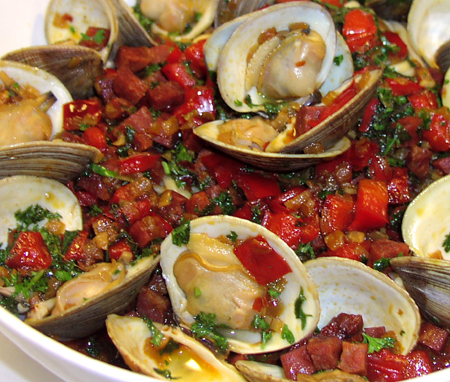
Linguine with Chorizo & Clams

Wednesday is my Sunday. It's the only day of the week that I'm sure to be off from work ,and usually all I want to do is relax at home with my cat asleep on my lap, or run around the park with Sadie. So lately, we've just been ordering in or eating at someplace local on my night off. Thing is, the eatery options in Eastern Queens are pretty, well, blah. (Any foodie neighbors with suggestions please let me know!) There are a couple of good pizzerias, a decent Indian restaurant, and several late night diners, but this girl can't live on pizza, curry, and burgers alone. Oh what I'd give for an authentic Mexican joint that's not run by the Chinese take out folks next door! There's nothing like having a craving for something good and ending up with a bland and disappointing meal. It's enough to drive a lazy cook back into her kitchen!

So this week, when I had a craving for seafood, I decided to take matters into my own hands. At least if the meal was a flop, I would have no one else to blame but myself. I have to say, I wasn't planning on getting clams. Pretty much every clam we've eaten in New York has had an unpleasant and bitter metallic finish that is unlike any clam we had in New England. But today I was visiting a new fishmonger who had both farmed Long Island clams, and wild caught Connecticut clams. He seemed to think the bitterness could be from the farmed clams. I was skeptical, but decided to gamble on the wild Connecticut clams and took a dozen of them home. Although they weren't as sweet as Rhode Island clams, they certainly didn't have a strong bitter finish, and I think the preparation helped to mask it.

At first I was going to go with a simple linguine and white clam sauce, but when I got home, I realized that I didn't have any white wine. I did have an open bottle of pinot noir, plenty of beer, red pepper and chorizo, so I ended up going in a more Spanish inspired direction. Improvising can be tricky, and believe me I've had my fair share of flops, but sometimes things do work out. Here's the recipe, approximately:

INGREDIENTS (serves 2 very generously):
4-5 Tbsp. extra virgin olive oil
1 large spanish (yellow) onion, diced small
1 large red bell pepper, diced small
3-4 cloves garlic
pinch of saffron
4 oz. dry chorizo sausage, diced small
1/2 lb. dry linguine or other pasta

2 plum tomatoes, seeded and diced
1/4 c. medium bodied red wine
1/4 c. lager beer
crushed red pepper
1 dozen small clams, such as cherrystones or liittlenecks, scrubbed clean
1/2 c. chopped fresh parsley
1-2 Tbsp. chopped fresh cilantro (optional)
salt and pepper

PROCEDURE:
1. First make a sofrito: In a medium sauce pan over low-medium heat, slowly cook the onions and red pepper in plenty of olive oil and a little salt until they are very soft. The onions should be transparent, and there should be no browning of the vegetables. Then add the garlic and saffron, and cook for another 30 seconds until the garlic is fragrant. Then add the chorizo and cook for another 5 minutes to develop the flavors.

2. While the sofrito is cooking, bring a large pot of salted water to a boil and cook the pasta. Place the chopped tomatoes in a colander, and drain the pasta into it, reserving 1/2 cup or so of the cooking liquid. Toss the pasta and tomatoes in a little olive oil to prevent it from sticking.

3. Add the wine, beer and crushed red pepper to the sofrito and turn the heat to high. As soon as the liquids come to a boil, add the clams, cover the pot, and reduce the heat to a simmer. Periodically give the pan a little shake until the clams steam open. Remove the clams and set aside, discarding any that do not open.

4. Add the fresh herbs to the pan and reduce the cooking liquid slightly. Season to taste, and toss with the pasta and clams, adding some of the pasta cooking liquid if necessary.

NOTES: Use good quality olive oil. It is a big flavor component in the sofrito, and if it doesn't have good flavor, the finished product definitely won't. The same goes for the beer and wine. Use stuff that tastes good enough to drink. The clams will absorb their flavors, and when the liquids reduce during cooking, the flavors will intensify as well.
AMAZON